Mental load at home
When your home feels like another job
A home can be full of people you love and still feel like one endless task list. The answer is not a perfect routine. It is building small systems that let the house serve the family again.
Your home is not supposed to feel like a place you clock into. It is supposed to hold your family, your routines, and your rest.
There is a kind of tired that happens when the house never stops asking for something.
The counter asks to be cleared. The laundry asks to be moved. The shoes ask where they belong. The papers ask for a decision. The toys ask to be reset. Dinner asks what the plan is. The calendar asks what everyone needs tomorrow.
For many busy moms, home is not only where life happens. It becomes the place where unfinished decisions collect.
And when every room holds another decision, the house starts to feel less like shelter and more like work.
Why home can start to feel heavy
A messy home is not just visually messy. It is mentally loud.
Every visible pile is a reminder that something still needs to be handled. Every item without a home becomes a tiny open loop. Every routine carried in your head takes up space that could have been used for rest, patience, creativity, or simply being present with your family.
This is why “just clean for 20 minutes” does not always solve the problem. Cleaning can make a room look better for a few hours, but if the same decisions keep returning, the mental load comes back too.
The real problem is often not that a mom is lazy, behind, or disorganized. The problem is that the home is asking one person to remember too much.
The goal is not a perfect home
Simple Home Rhythm is not built around perfect pantries, spotless playrooms, or routines that require a full free day.
Real family homes get messy. Kids bring things in. Laundry exists. Paper enters the house constantly. Meals have to happen again tomorrow. The goal is not to remove real life from the home.
The goal is to make the home easier to return to.
That means fewer floating decisions. Fewer mystery piles. Fewer routines that only live in one person’s head. More visible places where things belong.
A simple system gives the brain one less thing to hold
A system does not need to be complicated to work. In fact, the best systems for busy family life are usually very simple:
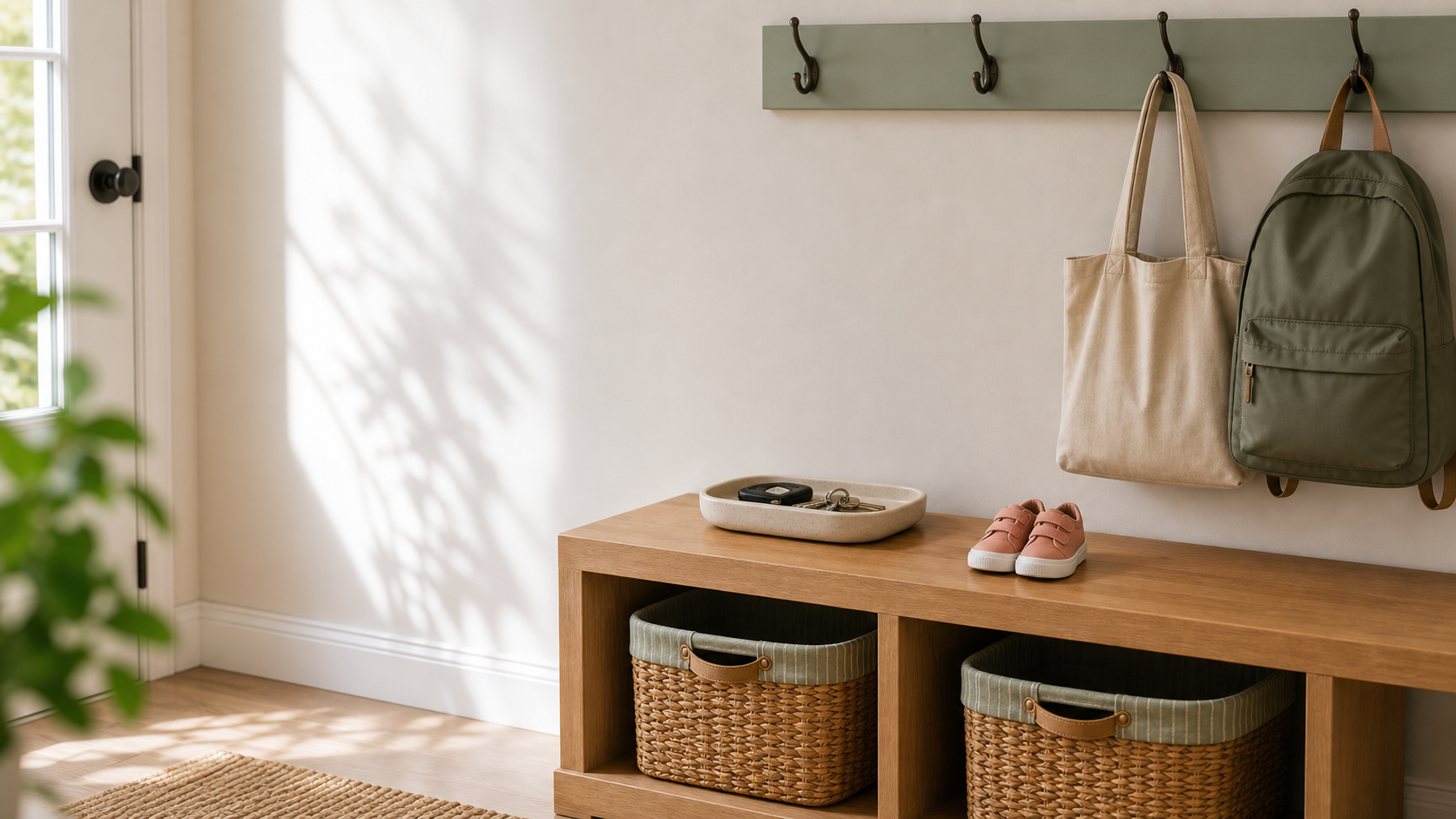
- a tray where keys always land
- a basket for items that need to leave the house
- one paper inbox for school forms and mail
- a weekly reset checklist on the fridge or clipboard
- a toy basket that is easy for children to use
- a small meal plan that answers the next few dinners, not the whole month
These are not glamorous systems. They are useful systems.
They work because they remove repeated decisions. Instead of asking “Where should this go?” every day, the answer is already visible.
Start with the loudest zone, not the whole house
When the whole house feels overwhelming, the instinct is to make a giant plan. But giant plans often create more pressure.
A better place to start is the zone that feels loudest right now.
Maybe it is the kitchen counter because everything lands there. Maybe it is paper clutter because every form feels urgent. Maybe it is the entryway because mornings begin with missing shoes and bags. Maybe it is the laundry because clean clothes never make it all the way back.
Choose one zone. Give that zone one clear job. Then give the most common items one visible home.
Simple reset question: What is one place in your home that keeps asking for attention every day?
Declutter first. Organize second.
Organization cannot fix too much stuff. If every basket is full, every drawer is crowded, and every surface has items waiting for a decision, adding more bins will only make arranged clutter.
Before organizing, edit the zone.
Remove what does not belong there. Return what already has a home. Let go of what is no longer useful for this season of family life. Then organize what remains.
This matters because calm does not come from hiding clutter inside prettier containers. Calm comes from making decisions easier.
How to make home feel like it serves you again
Start small enough that you can finish.
- Choose one pressure point.
- Remove what clearly does not belong.
- Give daily-use items one obvious home.
- Put the routine somewhere visible.
- Return to it gently the next day.
This is not about becoming a different person. It is about creating rhythms that support the person already doing so much.
A home should not depend on one tired brain remembering every detail. It should have simple places, simple routines, and simple resets that the family can return to.
A calmer home starts with one visible next step
If your home feels like another job, the answer is not to try harder at everything.
The answer is to take one routine out of your head and put it somewhere the home can hold it for you.
One checklist. One basket. One landing zone. One reset rhythm.
That is how the house slowly becomes less mentally loud. Not perfect. Lighter.
Free printable
Start with the free 7-Day Calm Home Reset Checklist.
Use it to choose one small focus each day instead of trying to reset the whole house at once.
Leave a Reply