
Kids spaces · paper decisions
What to Do With Kids’ Artwork: Display, Save, Photograph, or Release
Give each piece one job: enjoy a small rotating display, preserve a meaningful original, photograph an everyday record, or release what the family has decided not to keep.
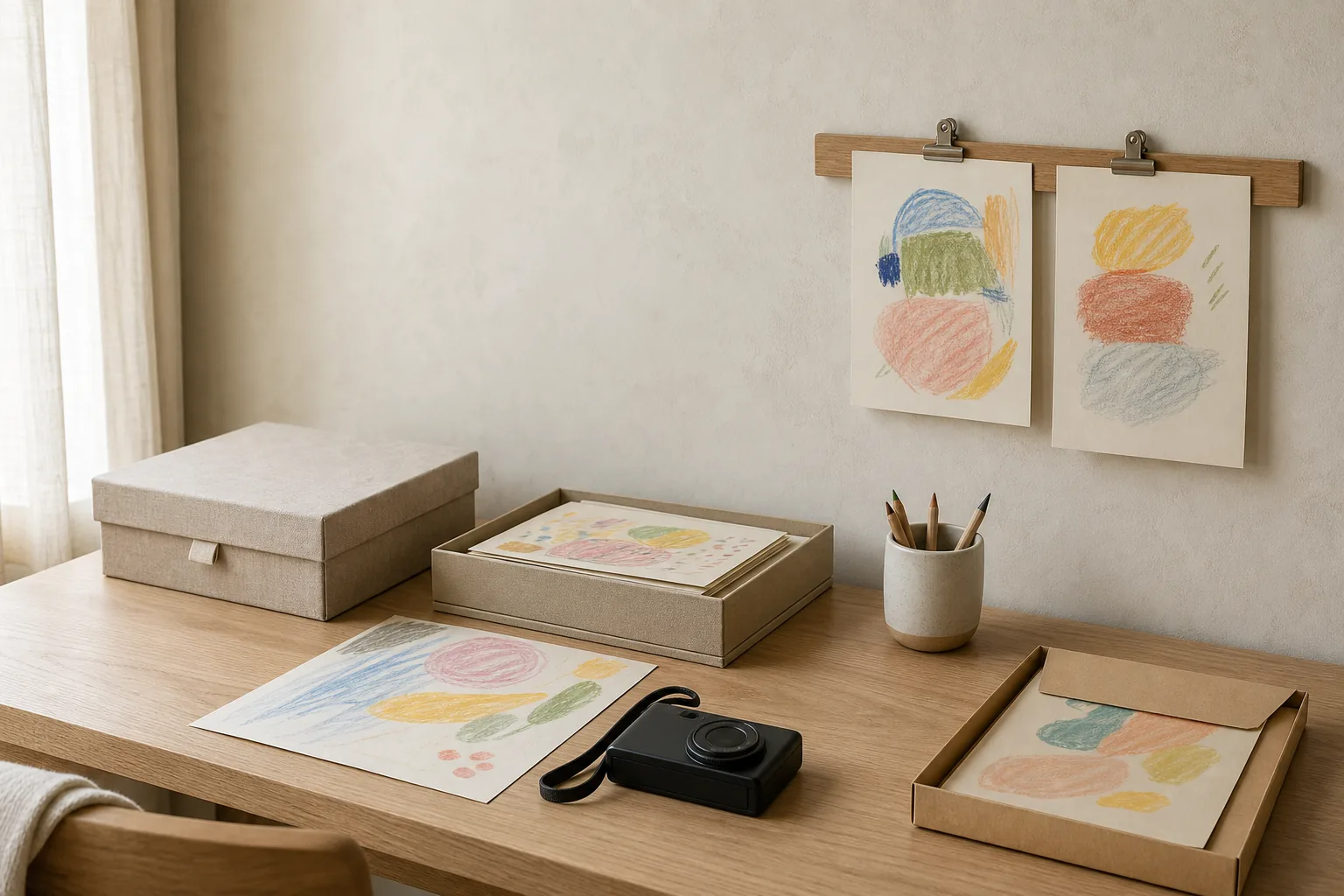
Decide the job of the piece before deciding the container.
Kids’ artwork can arrive faster than a family can look at it. The pile grows because several different intentions are mixed together: enjoy this now, preserve this original, remember this stage, or let this everyday page leave. A larger bin postpones those decisions but does not separate them.
Display, Save, Photograph, and Release is a household decision framework—not a rule about how much art a family should keep. One family may preserve a few originals each year; another may keep more. The useful boundary is the one the family can review and care for.
Start with one small intake boundary.
Choose one tray, portfolio, or week of papers. Remove school notices, worksheets needed for class, and adult-action forms first; those belong in the Paper Clutter workflow. Then consider the artwork one piece at a time.
Ask concrete questions: Do we want to enjoy this on the wall now? Does the original itself matter? Is a visual record enough for this everyday piece? Has the family chosen to release it? Avoid asking the child to rank an entire year of work at once.
The four artwork paths
Choose a small number to enjoy now on one rail, shelf, or frame. Rotate instead of expanding the display across every wall.
Preserve originals selected for their meaning, story, materials, or moment. Store them flat in suitable folders or boxes in a stable part of the home.
Create an easy-to-view record of an everyday piece before it leaves, or a reference image of an original that will also be saved.
Move the pieces the family has chosen not to display or preserve through the appropriate local recycling or disposal route.
The decision card
Use one line at a time. A piece needs only one primary next job.
- Display: enjoy now; rotate on a set boundary.
- Save: protect the meaningful original.
- Photograph: keep a useful visual record.
- Release: close the decision and use the correct local route.
Display a few pieces without asking paper to resist light.
Paper and colours can fade or change in light. The Canadian Conservation Institute recommends avoiding direct sunlight for works on paper and using protective glazing where appropriate. The U.S. National Archives notes that displaying a copy is the best protection from light damage when preservation matters.
Use one physically limited display—perhaps four clips or one frame ledge—and rotate on a natural family cue. If an original is especially meaningful or fragile, display a good copy and place the original in Save.
Save selected originals with material care.
Store flat pieces in acid-free folders or boxes, away from direct light, damp basements, hot attics, plumbing risks, and rapid temperature or humidity changes. Do not laminate an original or use pressure-sensitive tape as a preservation shortcut.
Pastel, chalk, charcoal, and other loose media need extra care. CCI cautions that ordinary plastic sleeves can develop static that lifts friable pigment. Place fragile or unusual materials in Save and consult a conservator or the specific institutional guidance rather than forcing every piece into the same sleeve.
Write identifying information on the folder or digital record instead of pressing hard on the artwork. If you must mark an ordinary paper item, follow archival guidance and keep the mark minimal and away from the image; do not improvise on fragile or valuable work.
Photograph for access, not as a promise of permanence.
Use even, indirect light, hold the camera parallel to the page, include the full edges, and check focus before releasing the paper. Add simple private metadata: child, date, title or story, and where it was made when that context matters.
The National Archives recommends recording basic who, what, where, and when information and maintaining backups. A digital file can still be lost, corrupted, or separated from its context. A photograph may not reproduce colour or texture exactly, and for a truly meaningful work it is not automatically a replacement for the original.
Create one folder structure the family can maintain, then back it up. Do not place a child’s full name, school, schedule, or other private identifying information in a public gallery unless the family has made a separate, informed privacy decision.
Release only after the decision is closed.
For everyday pieces the family has chosen not to preserve physically, a photograph can keep a visual memory before the paper is released. Especially meaningful or fragile originals belong in Save.
Check local recycling rules. Glitter, tape, glue, paint, foam, laminated sheets, and mixed-media objects may not belong in ordinary paper recycling. Remove personal information where appropriate and use disposal when local programs cannot accept the materials.
Make sentimental decisions without using guilt as storage.
A piece can matter even when it is not kept forever. The same distinction appears in How to Declutter Gifts Without Guilt: gratitude, memory, and physical storage are related but not identical decisions.
If the family no longer sees the individual works because every surface holds paper, use the small visual-boundary exercise in Clutter Blindness: A Five-Minute Visual Reset. The goal is not to erase evidence of childhood; it is to make the pieces chosen for display and preservation easier to see and care for.
Close the weekly artwork route.
Clear the intake tray, update the rotating display, file Save pieces, rename and back up photographs, and move Release pieces to their correct exit. Stop when the chosen boundary is empty. Visit the Kids Spaces hub for the other child-reachable systems that keep paper, toys, rooms, and daily handoffs connected.
If the adult needs a larger decision reset, use the free Declutter Reset Workbook before buying archive supplies. Decide the volume and destination first; choose the container second.
Sources and scope
These sources support the narrow guidance noted below. The household methods and stopping points in this article are Simple Home Rhythm frameworks, not clinical or developmental prescriptions.
- Canadian Conservation Institute — Basic Care of Art on Paper — Light exposure, acid-free storage, stable environments, and special caution for friable media.
- U.S. National Archives — Displaying Family Papers — Light damage and displaying a copy when protecting an original matters.
- U.S. National Archives — Digitizing Family Papers — Basic metadata, digital access copies, and maintaining backups.
Leave a Reply