
Kids spaces · toy decisions
How to Declutter Toys With Kids: A Calm 12-Item Sort
Bring only twelve toys to one small sorting surface, choose a clear home for Keep, a short review place for Pause, and a safe next step for Release—then stop before the project takes over the room.
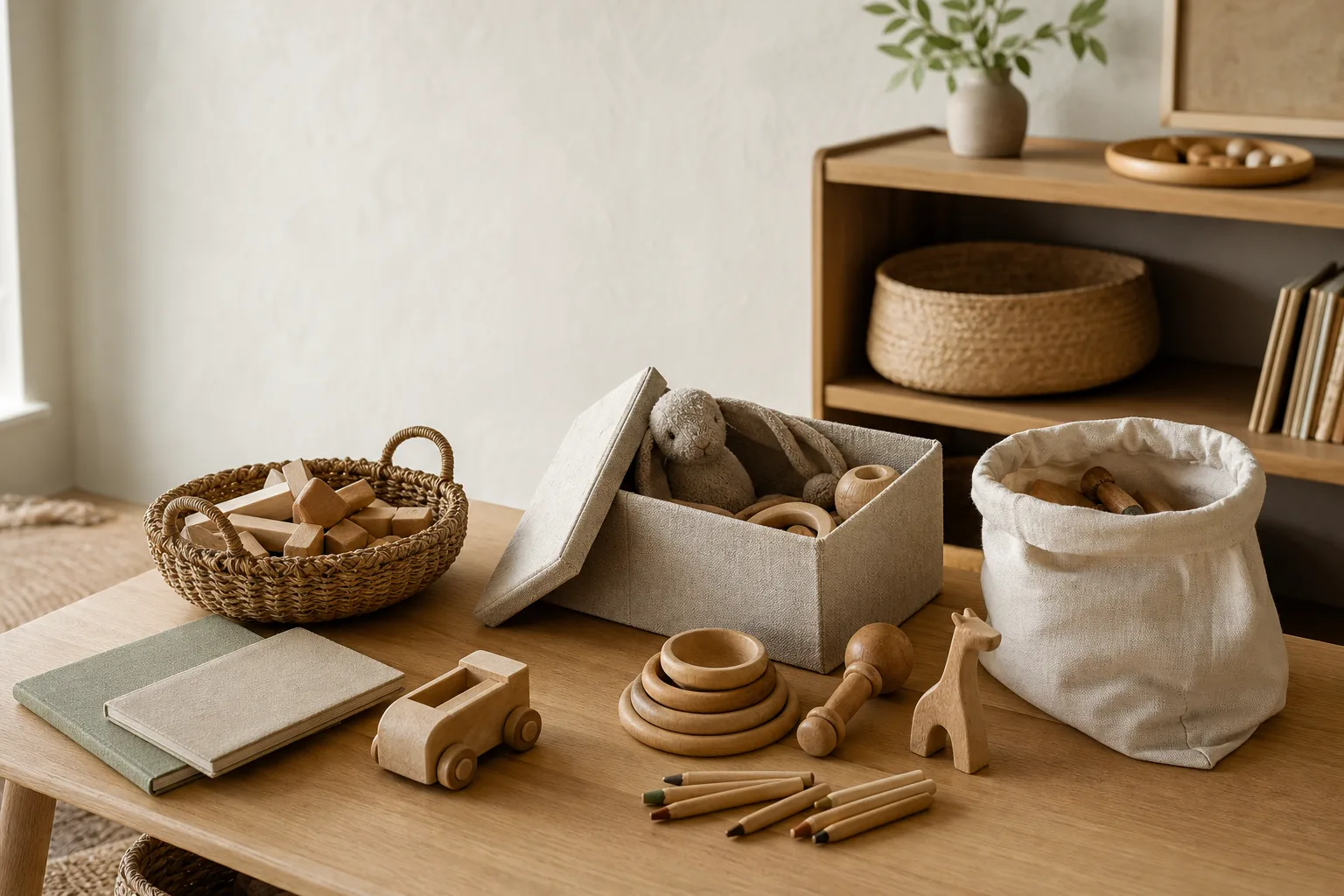
Choose one tiny boundary, not the whole toy collection.
Toy decluttering gets hard when every shelf, memory, broken piece, and future possibility enters the conversation at once. Start with one tray, one basket, or one square of the rug. Bring only twelve items into that boundary and leave every other toy where it is.
Twelve is our small-batch stop point, not a developmental rule or a scientifically ideal number. It simply gives the family a visible finish. Use six items, three items, or one item if that is the amount that fits the child and the day.
Set up Keep, Pause, and Release.
Give each decision a real destination before inviting the child to sort. Keep goes back to a reachable working home. Pause stays in one closed, dated container for a short family review. Release waits for an adult safety check and then follows the correct donation, hand-me-down, recycling, or disposal route.
For younger children, three options may be too many in one moment. Offer one toy at a time and reduce the question to two acceptable choices: “Keep this in the room, or put it in Pause?” The CDC’s guidance for young children recommends specific directions, a neutral tone, and a limited number of simple choices. That does not guarantee an easy decision, but it keeps the prompt concrete.
The calm 12-item sort
Name the shelf, basket, or toy type. Avoid “all the toys.” A boundary such as wooden blocks, toy animals, or the lower cubby is easier to finish.
Place the items where everyone can see them. The adult can remove anything that needs an immediate safety decision before the child begins.
Ask where this item belongs now. Do not turn the choice into a quiz about how recently it was used, how much it cost, or whether somebody else might be disappointed.
Return Keep items to a working home, date and close Pause, and move Release to an adult-only review place. Do not leave three new piles on the floor.
Even when the sort is going well, finish the batch. A dependable stopping point makes it possible to repeat another day without turning today into a marathon.
The three decisions
Use these as household categories, not judgments about the child or the toy.
- Keep: wanted now and has a reachable home.
- Pause: genuinely undecided and fits inside one dated review container.
- Release: no longer staying, pending the adult safety and exit check.
Use Pause as a decision tool, not hidden storage.
Choose a review date that your family can actually keep—perhaps the next monthly reset or before a birthday. The date is a prompt to decide again, not proof that an unused toy has no meaning. Open the container together when practical and make a new Keep or Release decision.
If the Pause container is already full, do not add another. Review what is there first. A single bounded container protects the method from becoming a second toy closet.
Run the adult safety gate before Release.
Before donating, selling, or passing on a toy, check current recall information, the age label, loose or small parts, sharp edges, batteries, cords, magnets, and overall condition. Health Canada advises checking toys regularly and repairing or discarding broken items; it also warns that a second-hand product that does not meet current safety requirements should not be given away or sold.
- Do not donate a recalled, broken, incomplete, or non-compliant toy.
- Keep small parts away from children who may put them in their mouths.
- Follow local rules for batteries, electronics, mixed materials, and recycling.
- Clean only according to the product’s instructions; do not use cosmetic cleaning to hide damage.
The adult owns this gate. A child can take an age-appropriate part in choosing, while the adult provides the structure and steps back only where the child is ready. That is consistent with Harvard’s broad guidance on scaffolding skills; it is not a claim that this toy sort improves executive function.
Return Keep items to broad, reachable homes.
Do not reward the sort by immediately buying more containers. First use the broad categories in Toy Storage That Does Not Take Over the Living Room. If the child can see where building toys, pretend play, vehicles, or art materials belong, the system is more likely to support the five-minute room reset.
When gifts are the emotionally difficult category, use the boundary questions in How to Declutter Gifts Without Guilt. A gift can be appreciated without requiring permanent storage.
Know when to stop and try a different day.
Stop if the task has moved beyond the agreed boundary, if every choice is being reversed, or if the adult is trying to persuade the child toward one answer. Put the current item back, close the containers, and protect the room from unfinished piles. The method is still complete when the family sorts fewer than twelve.
Visit the Kids Spaces hub for more child-reachable systems. If the larger home feels visually loud, the free Declutter Reset Workbook helps the adult choose one calm boundary before beginning.
Sources and scope
These sources support the narrow guidance noted below. The household methods and stopping points in this article are Simple Home Rhythm frameworks, not clinical or developmental prescriptions.
- CDC — Giving Directions — Specific directions, neutral tone, and limited simple choices for young children.
- Harvard Center on the Developing Child — Three Principles to Improve Outcomes — General scaffolding principle: adults provide appropriate support and step back as skills become ready.
- Health Canada — Toy Safety Tips — Age labels, small parts, regular checks, and broken-toy safety.
- Health Canada — Buying and Selling Second-Hand Products — Second-hand products still need to meet current safety requirements.
Leave a Reply